

This post may contain affiliate links. Check out our disclosure for more information.
Whether you are registering your RV, sorting out your insurance, or or even selling it, one little detail matters a whole lot: the Vehicle Identification Number (VIN). So how do you find the VIN number on a camper or travel trailer? I am going to walk you through exactly where to look and what to do if it’s missing or just hard to find.
What is a VIN Number and Why is it Important?
A Vehicle Identification Number (VIN) is a unique code that is an identifier for your RV. Your RV’s VIN number is like a fingerprint for your RV and is a 17-character code. This 17-digit number is an alphanumeric sequence that contains vital information about your rig.
The sequence of letters and numbers is not random, and each portion of the VIN can provide specific information that pertains directly to your RV. The service history of your RV is tied to this VIN and can be searched in order to find historical data for your RV.
Many RV owners also want to know the build date by VIN, which can be decoded using the 10th character of the VIN.
A VIN can tell you:
- Who built it (RV manufacturer)
- What kind of rig it is (travel trailer, fifth wheel, etc.)
- When it was made (10th character)
- Where it was built
- And its unique serial number
You’ll need your RV VIN number for things like:
- Getting insurance
- Registering your RV
- Transferring ownership (bill of sale)
- Running a vehicle history check
Do RV’s Have VIN Numbers?
Yes, all types of RVs, including towable recreational vehicles, have specific VINs. This identifying number must be applied to each RV, much like with cars. VINs can be located in various places on the RV, so it is essential to know where to find this important number.
The Department of Transportation (DOT) requires all vehicles, travel trailers, RVs, and towable products over a certain weight to have a VIN decal. If you cannot locate the VIN on your RV, it is important to contact your local DMV to apply for a new one.
Common VIN Location on Campers and RVs
There’s no one-size-fits-all answer to where the VIN is, but manufacturers tend to put the VIN sticker or VIN plate in a few common spots, depending on the type of RV.
Start by Checking Here:
Federal Certification Label:
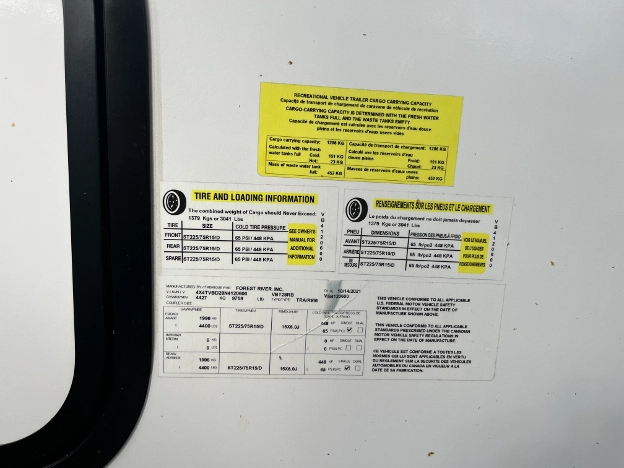
The Federal Certification Label is an information label (sometimes on a metal plate) that includes important manufacturer information and the VIN. This VIN number location can usually be found on the left front corner of the RV near the bottom of the sidewall. This VIN plate includes the VIN, Year, GVWR/GCWR, information about the tires, and other information. This information may also be found on a yellow sticker.
Travel Trailers & Fifth Wheels:
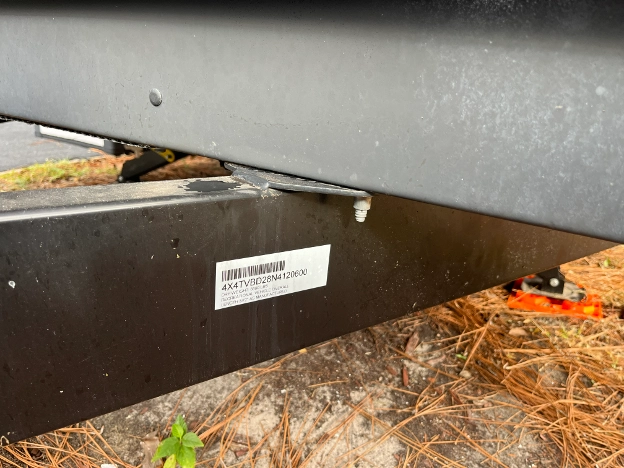
- On the frame rail near the tongue or hitch (usually on the driver’s side)
- Near the pin box if it’s a fifth wheel
- Inside a kitchen cabinet door or under the sink
- In the front storage bay
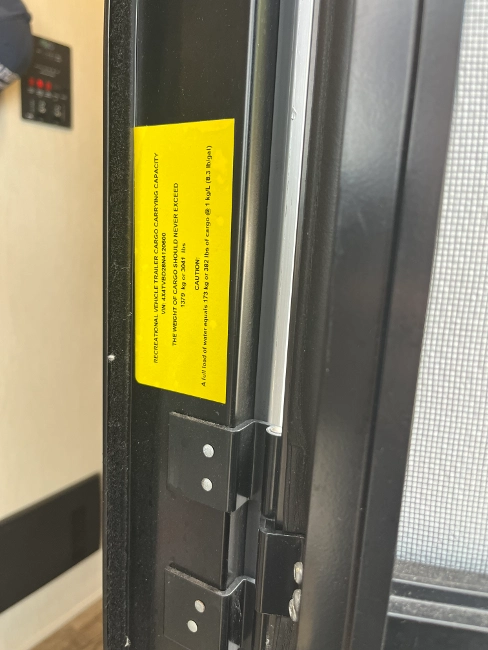
- On or near the main entry door frame (often on the door side of the camper)
Motorhomes (Class A, B, C):
- Driver’s side dashboard (check through the windshield)
- Inside the driver’s door frame or jamb
- Near the radiator or firewall area
- Front left corner of the RV body
- Front corner of the coach
- Steering column
- Wheel wells
- Machined on the front of the engine
Pop-Up Campers:
- Metal plate on the trailer tongue near the propane tanks
- Inside a cabinet or small interior compartment
- Under the kitchen counter or sink
- Entry screen door frame
Teardrop Trailers & Toy Haulers:
- Frame near the hitch
- Underbody supports (especially front or rear corners)
- Inside exterior storage access panels
If you’re looking for the VIN number on a camper trailer, these are the most common locations to check.
Pro Tip: If your VIN is on a sticker that’s starting to fade, snap a photo of it now. Future-you will thank you!
Can’t Find It Outside? Try These Documents
If the sticker’s missing or hard to read, don’t worry—you’ve got backup options:
- Your RV Title
- Registration paperwork
- Insurance documents or insurance card
- Bill of Sale
- Purchase documents from the dealer
If you bought your camper from a dealership, they’ll definitely have it on file.
Still Can’t Find the VIN? Here’s What to Do
- Re-check all the common locations listed above
- Go through your RV paperwork (title, registration, insurance)
- Call the dealership or previous owner
- Reach out to the RV manufacturer
- Contact your local DMV to ask about a replacement VIN or inspection
For older RVs, there’s a special process (see below).
Dealing with a Vintage Camper?
If your RV was built before 1980, it might not have a modern 17-digit VIN. Instead, look for a serial number or chassis ID.
Vintage campers may rely solely on a serial number for legal identification. This can be more challenging to trace, but it is still valid.
Here’s how to track down or apply for a VIN:
- Search the rig thoroughly for any stamped numbers or ID tags
- Contact the original manufacturer (or chassis maker)
- Gather proof of ownership (like a bill of sale or old paperwork)
- Visit your local DMV to apply for a VIN assignment
- Be prepared for a physical inspection—they may want to see the rig
Start the process as soon as possible—DMV requests can take time.
Can an RV Have Two VINs?
No, your RV will only have one VIN. An RV Chassis may have a separate VIN, so it’s important to pay close attention. The chassis may have been given it’s own VIN by the chassis manufacturer before the RV was incorporated. If you are using an RV chassis VIN, make sure you double-check the VIN in a separate location to ensure you are using the correct number.
Is the VIN the Same as the Serial Number?
Not quite. The VIN includes a serial number, but the two are not interchangeable. The serial number is just one part of the full 17-digit VIN. However, in a vintage camper, a serial number may be the only identifier available.
What Does an RV VIN Report Show?
An RV VIN report may offer insights like:
- Past accidents
- Theft or salvage history
- Mileage rollbacks
- Title records
- Warranty claims
- Manufacturer recalls
You can request a report from the following vin lookup services:
- Your state’s DMV
- An RV dealership
- Approved National Motor Vehicle Title Information System (NMVTIS) data providers
Always be cautious with online vehicle reports, as some of these are fraudulent. Always use approved data providers that can be found through NMVTIS.
What to Decode Your VIN?
Here’s what a typical RV VIN looks like: 1XKAD49X0GJ123456
And here’s what it means:
- Make (1–3): Manufacturer code
- Type (4): Type: T= Travel Trailer, F= Fifth Wheel, C= Folding Camper
- Model Number (5-7): Model Number
- Axles (8): 1= Single Axle, 2= Tandem Axles, 3= Triple Axles
- Check Digit (9): A safety check
- Year (10): Year code digit – See year code chart below
- Location (11): Plant location where the RV was built
- Serial Number (12–17): Sequential serial number

Want to know more? You can easily use a free decoder tool like NHTSA.com or Can-Am VIN decoder.
Buying or Selling? Don’t Skip These Steps
Before you hand over cash (or keys):
- Run a VIN report to check the RV’s history
- Make sure the VIN on the rig matches the title and registration
- Download our RV Inspection Checklist
- Keep VIN photos and service records together with our Maintenance Checklist
- Learn your rig’s systems using our RV Monitor Panel Guide
This post may contain affiliate links. Check out our disclosure for more information.
